
As the last of the snowbanks retreat from the yards of Traverse City and the surrounding Leelanau and Old Mission peninsulas, homeowners are shifting their focus from heating bills to home maintenance. In Northern Michigan, the roof is the first line of defense against an environment that is uniquely hostile to building materials.
From the relentless “lake effect” snow to the dramatic freeze-thaw cycles of March and April, our roofs take a beating that most shingles aren’t designed to handle without proper oversight. If you are assessing your property this spring, this guide explores the structural challenges and most frequent questions facing Northern Michigan roofing systems.
How do I know if I have ice dam damage after the snow melts?
For many in the Grand Traverse region, ice dams are an annual winter anxiety. However, the true damage often isn’t visible until the spring thaw. An ice dam occurs when heat escaping from your attic melts the bottom layer of snow on your roof. That water trickles down until it hits the cold eave (the overhang), where it refreezes into a block of ice.
This ice creates a literal dam, forcing subsequent snowmelt to back up under your shingles. Most shingles are designed to shed water moving downward with gravity; they are not waterproof barriers against standing water moving upward.
If you noticed heavy icicles this winter, start your spring inspection at the eaves. Look for shingles that appear “puffy,” curled, or lifted along the gutters. Even if you don’t see a leak inside the house yet, water may have reached the wooden roof deck. This can cause slow-moving rot and mold that compromises the structural integrity of your home over time. If you see dark staining on the wood in your attic or damp insulation near the edges of the house, the ice dam successfully breached your roof’s defense.
What are the best shingles for high-wind areas near the Great Lakes?
Lake Michigan is beautiful, but the spring wind gusts it sends across the shoreline can reach speeds exceeding 50 or 60 mph. These aren’t just “breezes”—they are powerful enough to test the adhesive bond of any roofing system.
When a shingle is installed, it relies on a “thermal seal”—a strip of adhesive that bonds to the shingle below it. In the cold Northern Michigan spring, these seals can become brittle. A high wind gust can catch the edge of a shingle and lift it. In our region, we recommend architectural shingles specifically engineered with reinforced nailing zones.
Standard 3-tab shingles are often rated for only 60 mph, which is a common occurrence in a Traverse City spring. Upgrading to a GAF Master Elite level shingle, like the Timberline HDZ, provides a layer of protection that can withstand much higher gusts. This ensures that even during a “Big Lake” storm, the thermal seal stays intact and your roof remains a cohesive unit.
Can I just repair shingle damage from a wind storm, or do I need a new roof?
One of the most common questions homeowners ask after a storm is whether a patch is a viable long-term solution. The answer depends entirely on the age of the roof and the extent of the “wind lift.”
If your roof is less than 10 years old and the damage is isolated to a small area, a professional repair is often a great way to extend the life of the system. However, as shingles age, they lose their pliability. Asphalt becomes brittle as the oils evaporate over time. Attempting to lift an old shingle to slide a new one underneath can often cause the old shingle to crack, creating more damage than the original storm did.
If more than 20% of your roof shows signs of wind lift, missing tabs, or significant granule loss, a full replacement is usually the more cost-effective move. Patching an expiring roof is often a temporary fix that fails to address the underlying systemic weakness.
Does homeowner’s insurance cover roof leaks caused by snow load?
When you discover damage, the financial weight can be overwhelming. Many Michigan homeowners are surprised to learn that their policy likely covers “Weight of Ice and Snow” or “Wind Damage.”
However, insurance companies are increasingly looking for reasons to deny claims based on “lack of maintenance.” For example, if an ice dam caused a leak, but the adjuster finds that your attic was improperly ventilated (the root cause of the ice dam), the claim process can become complicated.
The key to a successful claim is professional documentation. Having an expert record the specific “point of failure”—whether it’s hail bruising, a broken thermal seal from wind, or damage specifically caused by a snow load event—provides the objective evidence needed to prove the damage was a result of a weather event rather than general age or neglect.
What is the average cost of a roof replacement in Traverse City?
Pricing is rarely transparent in the roofing industry, which often leads to “sticker shock.” In Northern Michigan, you aren’t just paying for shingles; you are paying for the labor required to navigate steep pitches and the heavy-duty materials required for our climate.
A standard 2,000-square-foot home in the Traverse City area typically sees replacement costs ranging from $9,000 to $16,000. Why such a wide range?
- Pitch: A steep roof requires more safety equipment and takes significantly longer to strip and shingle.
- Layers: If you have two layers of old shingles, the labor cost for removal and the disposal fees at the local landfill will effectively double.
- Decking: If winter moisture has rotted the plywood underneath, those sheets must be replaced to ensure the new shingles have a solid foundation to nail into.
- Valleys: A roof valley is the internal angle where two sloping roof sections meet. These are the “highways” of your roof, carrying more water and snowmelt than any other section. Because they handle such high volume, they are common points of failure. Investing in high-quality valley liners or open metal valleys is a smart move for Northern Michigan homes that face heavy snowfall.
How much does a professional roof inspection cost in Northern Michigan?
A “free estimate” is often just a sales pitch in disguise. A true Professional Roof Inspection is an investment in your home’s future. In our region, an inspection typically costs between $200 and $450.
A real inspection involves more than just a glance from the driveway. A pro will get on the roof, check the flashing around the chimney, inspect the attic for “daylight” (a sign of ventilation gaps), and check moisture levels in the insulation. In Northern Michigan, catching a failing flashing seal around a vent pipe might cost a few hundred dollars to fix today. Waiting until that small gap causes the ceiling to collapse during a November rainstorm could cost thousands in interior restoration.
How do I remove moss and algae from my roof without damaging shingles?
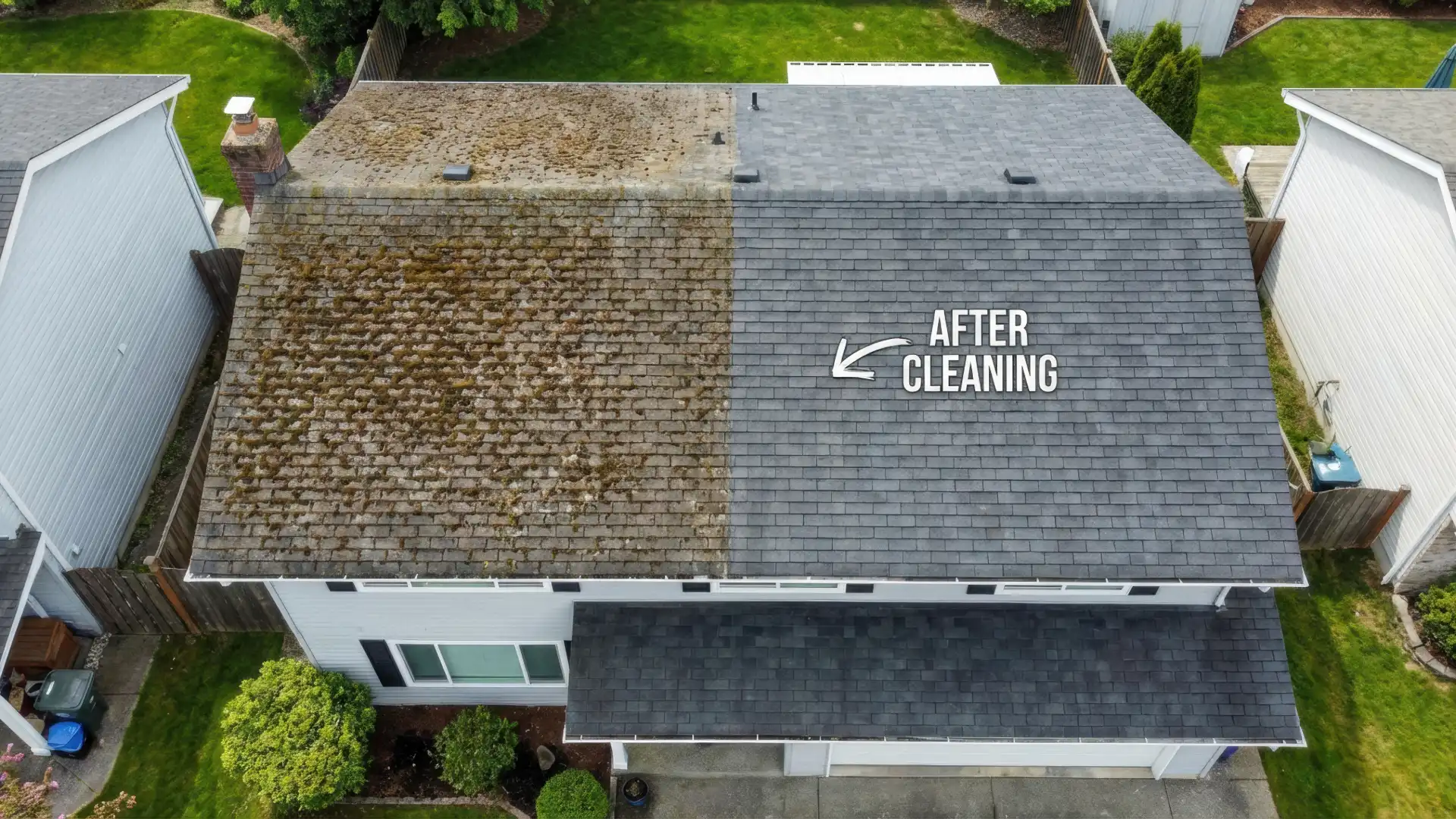
If your home is nestled in the woods or near the water, you’ve likely seen those dark black streaks or green moss clumps on the north-facing side of your roof. This isn’t just an aesthetic issue; moss acts like a sponge, holding moisture against the shingle and eventually rooting itself into the asphalt.
Never use a power washer on your roof. The high-pressure water will strip away the ceramic granules that protect the asphalt from UV rays, effectively aging your roof by a decade in ten minutes. Instead, maintenance should involve a “soft wash” solution. Most professionals use a mixture of water and sodium hypochlorite to kill the spores at the root, allowing the rain to wash away the dead organic matter naturally over time without compromising the shingles.
What is the best time of year to schedule a roof replacement in Michigan?
In Michigan, we have a limited “Goldilocks” window for roofing. You need it to be warm enough for the shingles to seal, but not so hot that the asphalt becomes “scuffable” under a worker’s boots.
The ideal window is late April through June, and again in September through October. Scheduling a replacement in the spring is strategically smart; it ensures that any damage done over the previous winter is removed before the heavy humidity of July and the high-energy thunderstorms of late summer arrive.
Protecting Your Northern Michigan Investment
At MI Roof Pro, we understand that your home is likely your largest asset. We focus on what actually matters to our neighbors: structural integrity, honest communication, and professional craftsmanship.
Whether you are in the heart of Traverse City or managing a property in the Clarkston area, our goal is to provide clarity in an industry that can often be confusing.
Ready for a clear picture of your roof’s health? * Get an Instant Projection: Use our digital estimator to see where your project stands in seconds.
- Schedule a Discovery Call: Let’s discuss your specific concerns, from insurance claims to high-wind shingle options.